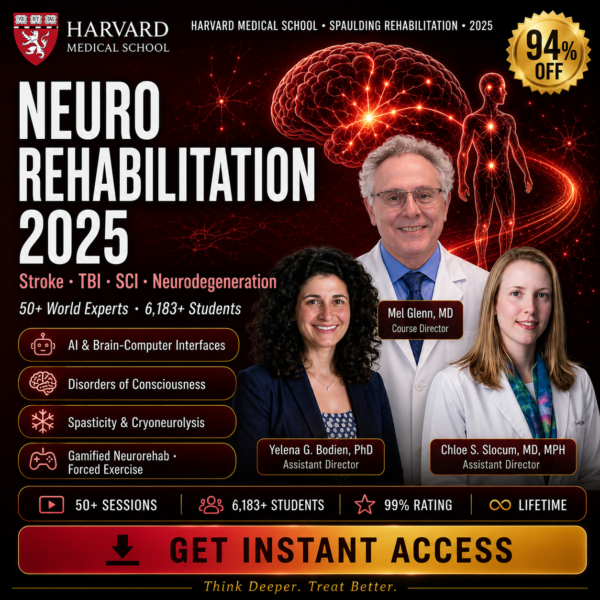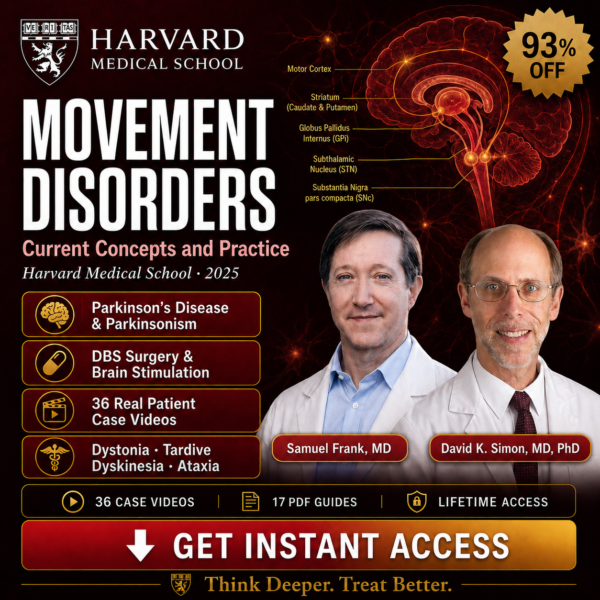
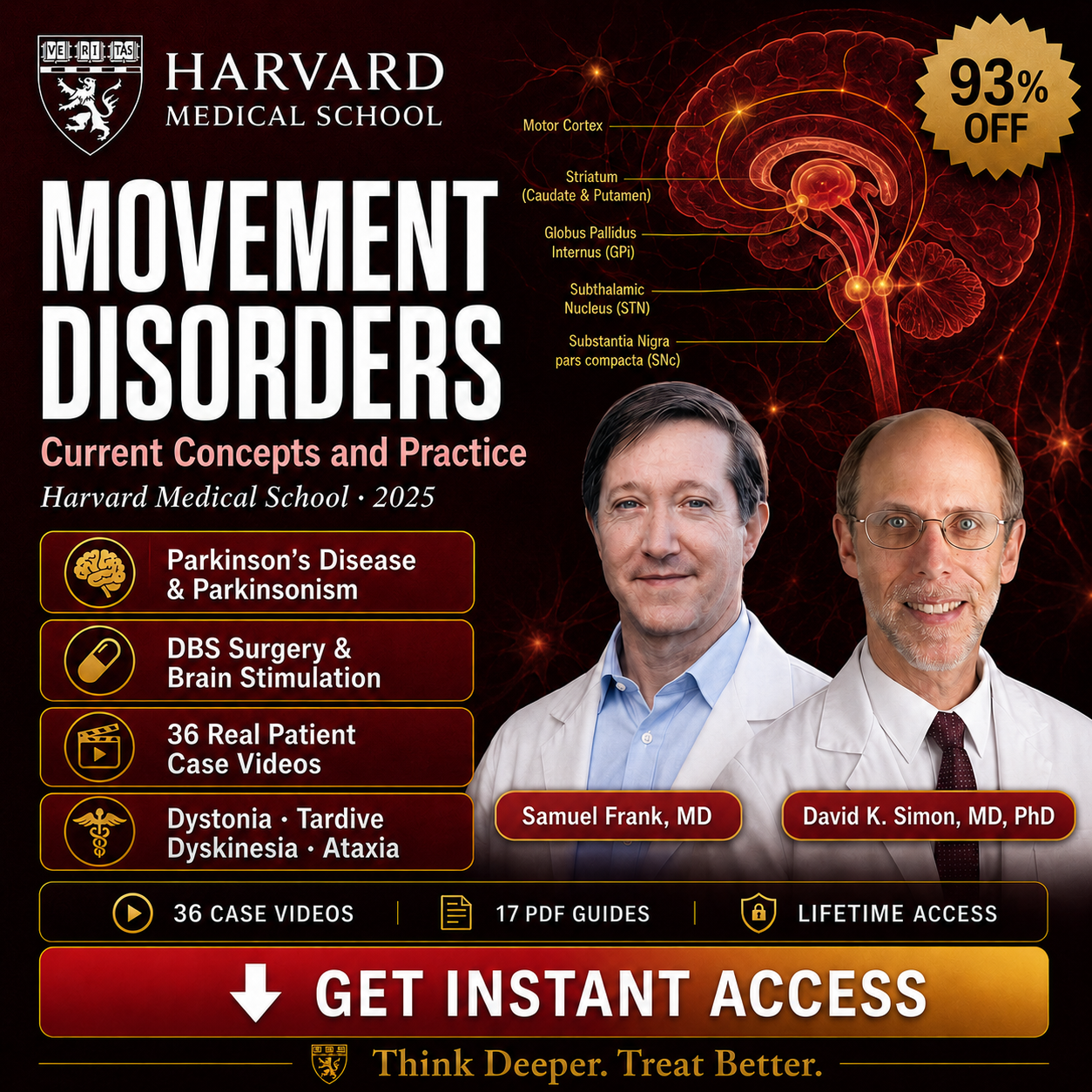
Harvard Movement Disorders Current Concepts and Practice 2025
Original price was: $750.00.$109.00Current price is: $109.00.
4.9
(41 reviews)
Harvard Medical School’s definitive movement disorders course — 36 real patient case videos, 17 PDF guides, and 2-day expert curriculum covering Parkinson’s, DBS, dystonia, tardive dyskinesia, ataxia, and functional movement disorders.
48 viewing now
🔥 Bestseller
Secure payment via


| 🔒 Secure Checkout |
↩️ 30-Day Refund |
♾️ Lifetime Access |
✅ Instant Download |
🎓 HARVARD MEDICAL SCHOOL · CME ACCREDITED · 2-DAY COURSE · ON-DEMAND 2025
Movement Disorders: Current Concepts and Practice 2025
Enhance your clinical expertise in diagnosing and managing complex movement disorders — featuring 36 real patient case videos, expert insights, and practical strategies from Harvard’s leading neurologists at BIDMC and MGH.
⚡ Instant Digital Access — Google Drive
Includes: 36 Patient Case Videos + 17 PDF Guides · Lifetime Access
36
Patient Case Videos
17
PDF Guides
2
Day Course
∞
Lifetime Access
📚 Course Overview
Movement disorders like Parkinson’s disease and essential tremor are common yet frequently misdiagnosed. Other highly treatable disorders — drug-induced movement disorders, dystonia, and tics — remain difficult to recognize, posing obstacles to timely treatment.
This Harvard CME course covers current pathophysiology, evidence-based evaluation, treatment guidelines, and non-motor aspects of Parkinson’s disease — culminating in interactive video-based case rounds with real patients to sharpen clinical recognition and decision-making.
“The video case rounds were the difference-maker. I finally feel confident separating tremor phenotypes and spotting red flags for atypical parkinsonism.” — Amina R., Neurology Resident
🎯 Learning Objectives
- ✓ Evaluate and diagnose movement disorders — PD, Huntington’s, dystonia, tremor, myoclonus, tics, chorea, and tardive dyskinesia.
- ✓ Recognize pitfalls in diagnosing Parkinson’s disease, tremor, or dystonia — and avoid common misdiagnosis errors.
- ✓ Assess therapeutic uses of botulinum toxin injections for dystonia and related disorders.
- ✓ Screen candidates for deep brain stimulation (DBS) and understand pre/post-operative evaluation.
- ✓ Describe non-motor aspects of Parkinson’s disease including mood disorders and cognitive impairment.
- ✓ Interpret dopamine blocker pharmacology and its role in tardive dyskinesia pathophysiology and management.
📋 2-Day Course Agenda
Harvard Medical School · Beth Israel Deaconess Medical Center · Massachusetts General Hospital
Day 1 — Parkinsonism, Tremor, Gait & Movement Disorders
Overview of Movement Disorders
Ludy Shih
Clinical Approach to Gait Disorders
Lan Luo
Tremor and Myoclonus
Shabbir Merchant
Chorea and Huntington’s Disease
Samuel Frank
Diagnosis of Parkinsonism and Early Treatment
David K. Simon
Management of Advanced Parkinsonism
David K. Simon
Nonmotor Aspects & Atypical Parkinsonism
Veronique VanderHorst
🎬 Movement Disorders Video Case Rounds
VanderHorst · David K. Simon
Day 2 — Dystonia, DBS, Ataxia, Tics & Functional Disorders
Tardive Dyskinesia & Drug-Induced Movement Disorders
Samuel Frank
Dystonia: Phenomenology, Classification, and Treatment
Samuel Frank
Clinical Evaluation of Ataxia Syndromes
Jeremy Schmahmann
Tourette Syndrome
Kinga Tomczak
Restless Leg Syndrome
John Winkelman
Cognitive & Psychiatric Aspects of Parkinson’s Disease
Daniel Press
Introduction to Brain Stimulation
Michael Fox
DBS Surgery: Procedures and Outcomes
Ron Alterman
Functional Movement Disorders
David Perez · MGH
🎬 Movement Disorder Video Case Rounds
Samuel Frank · Ludy Shih
👨⚕️ Course Directors & Faculty
Harvard Medical School neurologists from BIDMC, MGH, and Brigham & Women’s Hospital.
David K. Simon, MD, PhD
COURSE DIRECTOR
Professor of Neurology, HMS · Chief, Division of Movement Disorders · BIDMC
Samuel Frank, MD
COURSE DIRECTOR
Associate Professor of Neurology, HMS · Director, HDSA Center of Excellence · BIDMC
Michael D. Fox, MD, PhD
Director, Center for Brain Circuit Therapeutics · BWH/MGH/BIDMC
Ron Alterman, MD
Chief, Division of Neurosurgery · BIDMC
Jeremy Schmahmann, MD
Founding Director, Ataxia Unit · MGH
David Perez, MD, MMSc
Director, MGH Functional Neurological Disorders Clinic
John Winkelman, MD, PhD
Chief, Sleep Disorders Clinical Research · MGH
Veronique VanderHorst, MD, PhD
Associate Professor of Neurology · HMS
Kinga Tomczak, MD, PhD
Director, Tic Disorders & Tourette Program · Boston Children’s
Daniel Press, MD
Clinical Director, Cognitive Neurology Unit · BIDMC
🎯 Who Should Participate?
Designed for clinicians seeking practical, evidence-based guidance in the diagnosis and management of movement disorders — from primary care to neurology specialists.
Primary Care Physicians
Movement Disorder Fellows
Psychiatry Clinicians
Nurse Practitioners
Physician Assistants
Pharmacists
Psychologists
⭐ What Clinicians Say
“The video case rounds were the difference-maker. I finally feel confident separating tremor phenotypes and spotting red flags for atypical parkinsonism. Practical, structured, and immediately useful on service.”
Amina R. — Neurology Resident
“Clear approach to gait disorders and drug-induced syndromes. The PDFs are concise, and the medication pearls helped me counsel patients better. This is exactly the kind of practical update primary care needs.”
Javier M. — Family Physician
“Excellent coverage of tardive dyskinesia and dopamine-blocker pharmacology. The course helped me recognize subtle phenomenology and coordinate care with neurology sooner.”
Sarah K. — Psychiatry Clinician
🔒 CME Accredited · Harvard Medical School · Lifetime Access
Think Deeper. Treat Better.
Join clinicians mastering movement disorders with Medicalosa.