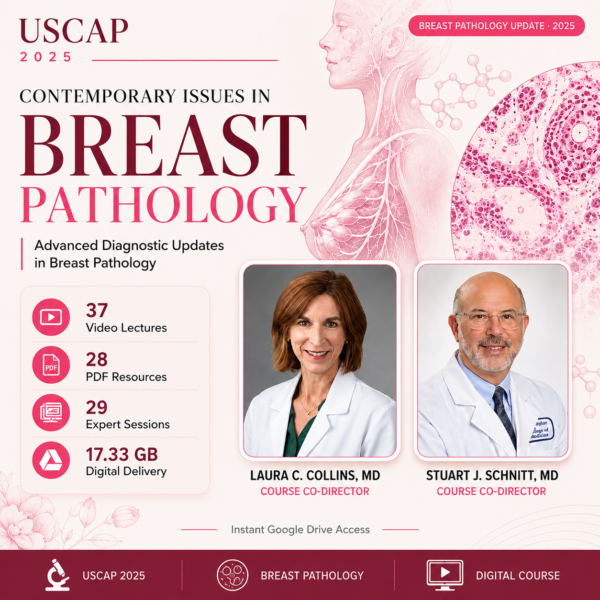
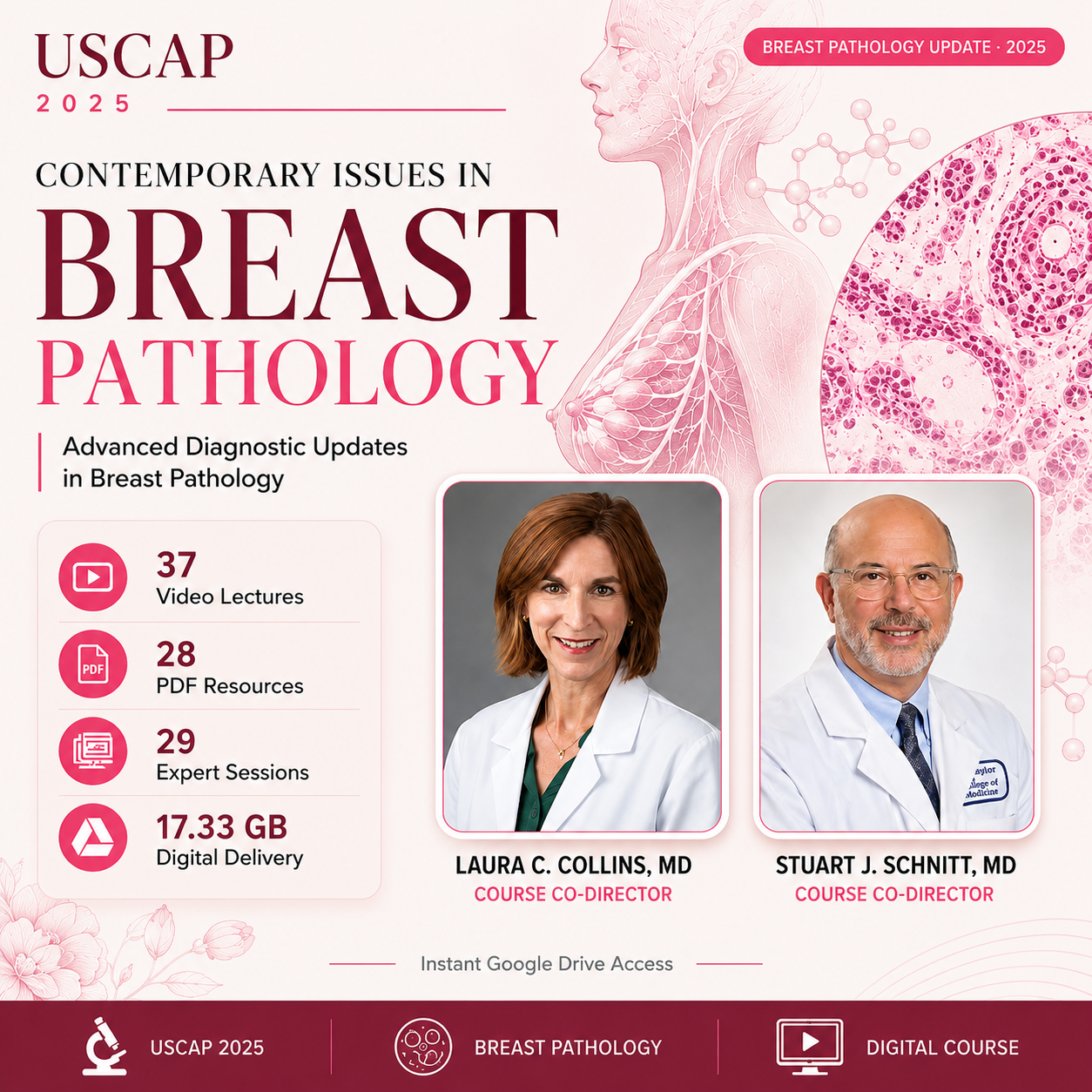
USCAP 2025 Contemporary Issues in Breast Pathology
Original price was: $2,200.00.$149.00Current price is: $149.00.
4.9
(91 reviews)
🔬 Expert-led review of benign, in situ and malignant breast lesions — intraductal proliferations, LCIS, papillary and fibroepithelial lesions, spindle cell and vascular tumors, triple-negative and HER2-low cancers, immunohistochemistry, molecular testing, digital slides and AI. 37 videos + 28 PDFs · 17.33 GB.
54 viewing now
Secure payment via


| 🔒 Secure Checkout |
↩️ 30-Day Refund |
♾️ Lifetime Access |
✅ Instant Download |
⚡ INSTANT DIGITAL ACCESS
Includes: 37 Video Lectures + 28 PDF Resources | Total Size: 17.33 GB | Google Drive delivery
📚 Course Overview
USCAP 2025 Contemporary Issues in Breast Pathology provides a comprehensive review and update of the pathologic diagnosis and clinical significance of benign, in situ and malignant breast lesions encountered in surgical specimens and core needle biopsies.
The program emphasizes difficult differential diagnostic problems and the most current uses of adjunctive immunohistochemical and molecular studies — how these tools support lesion classification, improve diagnostic accuracy, and help guide patient management.
The curriculum combines expert lectures with digital slide sessions covering atypical proliferations, fibroepithelial lesions, spindle cell and vascular lesions, triple-negative neoplasms, mucinous lesions, ER-positive cancers and unusual breast tumors.
Strengthen diagnostic confidence across the full spectrum of breast pathology — from routine core biopsies to the cases that stop you at the microscope.
🎯 Why Review This Program
A practical update for challenging breast pathology cases
🔍 Diagnostic Coverage
Key areas across contemporary breast pathology
✅ Learning Outcomes
Describe the diagnostic criteria and clinical significance of benign, in situ and malignant breast lesions in surgical specimens and core needle biopsies.
Discuss differential diagnostic problems and build a more focused approach to difficult cases.
Apply immunohistochemical and molecular tests appropriately while recognizing their uses and limitations.
Discuss prognostic and predictive assays used in patients with breast cancer.
Improve interpretation of post-neoadjuvant specimens, lymph nodes, unusual lesions and contemporary breast cancer subtypes.
👩🔬 Expert Faculty
Learn from recognized breast pathology specialists
🔬 Primary Audience
Designed for pathologists managing breast specimens
📋 Complete Curriculum
29 expert-led sessions and digital slide reviews
02. Update on Classification and Management of LCIS — Stuart Schnitt, MD
03. Contemporary Issues in Breast Core Needle Biopsies — Laura Collins, MD
04. Digital Slides: Small Glandular Proliferations — Laura Collins, MD
05. Digital Slides: Atypical Intraductal Proliferations — Cecily Quinn, MD
06. Inflammatory and Reactive Lesions — Cecily Quinn, MD
07. Papillary Proliferations — Edi Brogi, MD, PhD
08. Challenging Fibroepithelial Lesions — Puay Hoon Tan, MD
09. Apocrine Proliferations — Cecily Quinn, MD
10. Digital Slides: Fibroepithelial Lesions — Puay Hoon Tan, MD
12. Vascular Lesions — Gregory Bean, MD, PhD
13. Applications of Molecular Testing in Breast Cancer — Ashley Cimino-Mathews, MD
14. Classic TNBC, TILs and the Immune Microenvironment — Ashley Cimino-Mathews, MD
15. Special Type Triple Negative Breast Cancers — Laura Collins, MD
16. HER2-Low and ER-Low Breast Cancers — Stuart Schnitt, MD
17. Pathologic Evaluation After Neoadjuvant Therapy — Gregory Bean, MD, PhD
18. Digital Slides: Spindle Cell and Vascular Lesions — Gregory Bean, MD, PhD
19. Digital Slides: Triple Negative Breast Neoplasms — Stuart Schnitt, MD
21. Specimen Handling and Margin Evaluation — Laura Collins, MD
22. Epithelial-Myoepithelial Proliferations — Puay Hoon Tan, MD
23. Uncommon Clinical Scenarios — Edi Brogi, MD, PhD
24. Digital Slides: Mucinous Lesions and ER+ Breast Cancers — Ashley Cimino-Mathews, MD
25. Digital Slides: Unusual Breast Lesions — Edi Brogi, MD, PhD
26. Uncommon Types of Invasive Breast Cancers — Gregory Bean, MD, PhD
27. Contemporary Lymph Node Evaluation — Edi Brogi, MD, PhD
28. Applications of AI to Breast Pathology — Stuart Schnitt, MD
29. Panel Discussion and Q&A — Expert faculty
📦 Delivery & Access
💬 What Pathologists Say
“The digital slide sessions are the strongest part. Genuine pattern recognition practice, not just lecture slides.”
Dr. Helena K. — Surgical Pathologist
“The HER2-low and ER-low content is exactly the update I needed. Clear on where the thresholds actually sit.”
Dr. Tomás R. — Breast Pathology Fellow
“Excellent coverage of fibroepithelial and spindle cell lesions — the cases that cost me the most sign-out time.”
Dr. Amara O. — Community Pathologist
$149
Complete breast pathology program — 37 video lectures + 28 PDFs · 17.33 GB. Instant access, lifetime learning.
Our support team is available around the clock — email us at support@medicalosa.com and we’ll get back to you quickly.